
Concrete
Concreters in Southport and the North West
Concrete bases, floors, yards and slabs, laid for homeowners and builders. We do the whole job: dig out, sub-base, steel, pour and finish. Most concrete fails because of what is under it, and that is the part we are best at.
What we lay
Garden room and garage bases
A flat, level, reinforced base that the building is fixed to. Dug out, sub-base, membrane, steel and concrete, square and to the size the supplier asks for.
Floors
Garage, workshop and outbuilding floors, plus the oversite concrete (the slab inside the walls) in a new extension. Smooth enough to walk, park or build on.
Yards and hardstandings
Concrete yards, parking areas and bases for tanks, plant and storage, laid to falls so the rain runs off to a drain.
Reinforced slabs for builders
Ground bearing slabs for industrial units and new builds, with the steel, thickness and joints to the engineer's drawing.
Foundations
Strip and trench fill footings for extensions and new walls, poured to what building control and the engineer need.
Concrete driveways
Plain or pattern imprinted, on the same dug out and compacted base as every other slab we lay.
A concrete supplier and a concreter are not the same
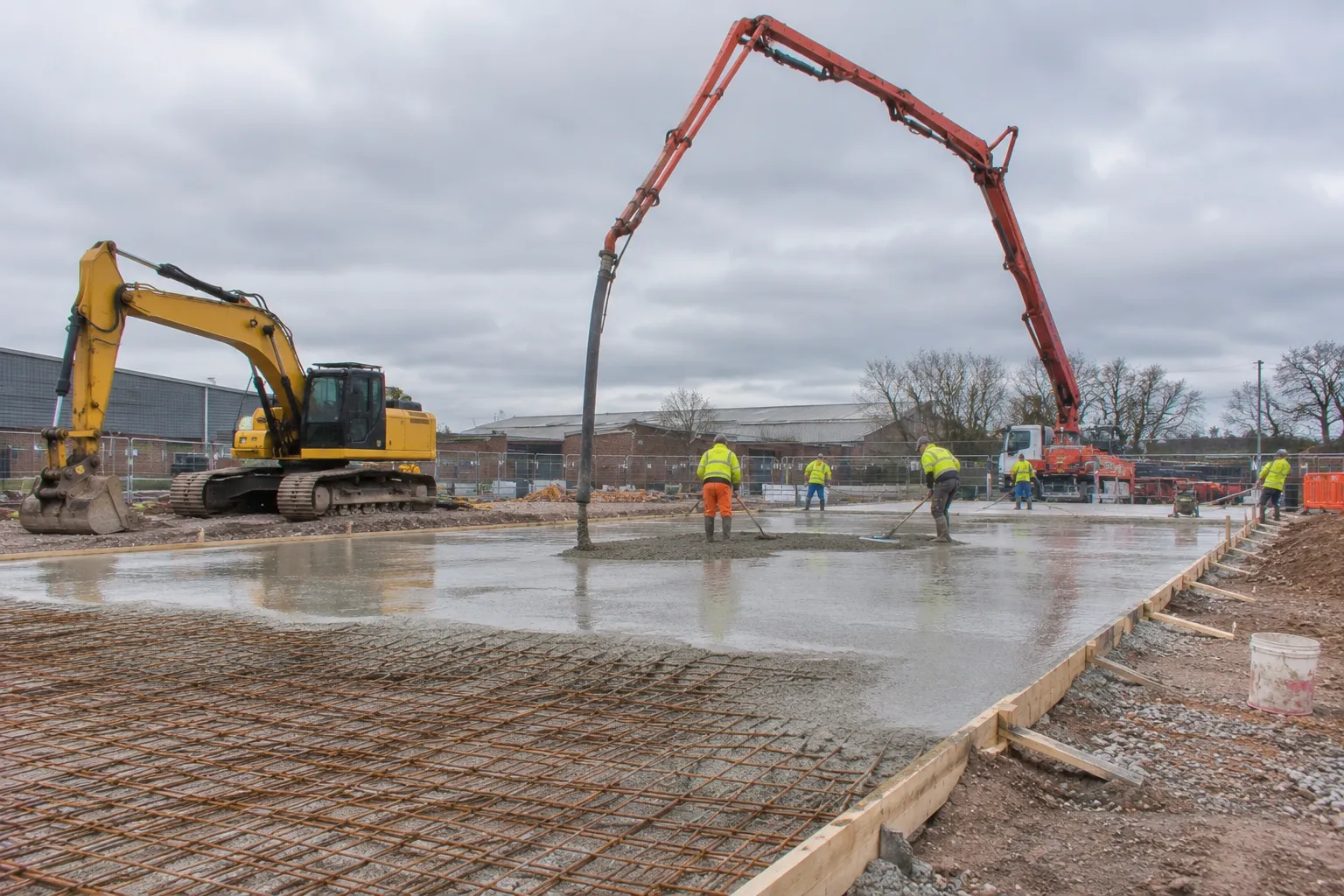
A ready mix firm brings the concrete on a wagon and goes. Someone still has to dig out, lay and compact the sub-base, set the edges level, put the steel in, then lay, compact and finish the concrete before it goes off.
That is us. We order the concrete ourselves, to the right strength for the job, and we are there with the machines and the crew when the wagon turns up.
What makes a slab last
The concrete you see is the last layer. These are the ones that decide whether it cracks.
- 1
Firm ground
Topsoil and soft ground come out. Concrete laid on soft ground sinks and cracks, however thick it is.
- 2
Sub-base
Type 1 (crushed stone) spread and compacted in layers with a roller or plate, so nothing moves underneath.
- 3
Membrane
A heavy plastic sheet under the concrete to stop damp coming up through it. Inside a building it is called the DPM, damp proof membrane.
- 4
Reinforcement
Steel mesh or fibres in the concrete to hold it together and stop small cracks opening up.
- 5
The right thickness
Set by what goes on it. A shed needs less than a car, a car needs less than a loaded van. For buildings, the engineer or building control decides.
- 6
Joints and curing
Joints cut so the slab moves along a line you choose, not a crack. Then it is kept covered and damp so it does not dry out too fast.
For builders and main contractors
We take on concrete-only packages: formation, sub-base, steel fixing, pour and finish to your drawing, with saw cut joints where the engineer wants them.
£10M public liability, CSCS carded crews, RAMS supplied, and our own grab lorries for the muck away.
All our commercial groundworks950 m²
Industrial slab and earthworks, Warrington, WA5
1,200 m³ of cut and fill, the ground stabilised through soft mudstone, then a power floated concrete slab with saw cut joints.
How we lay a concrete slab
The pour takes an hour or two. The days before it decide how long the slab lasts.
- 1
Look and measure
Size, levels, ground, what is going on the slab and how we get the concrete in. Then a written quote.
- 2
Dig out
Down to firm ground. The spoil goes away on our own grab lorries, which are licensed as an upper-tier waste carrier.
- 3
Sub-base
Type 1 laid and compacted in layers, to level or to falls.
- 4
Formwork and membrane
Timber or steel edges set out square and level, then the membrane laid and lapped.
- 5
Steel
Mesh lifted on spacers so it sits inside the concrete, not on the bottom, or fibres added in the mix.
- 6
Pour
Ready mixed concrete ordered to the right strength, poured in one go and compacted so there are no air pockets.
- 7
Finish
Tamped, brushed or power floated to suit the job. Then joints cut and the slab covered to cure.
Questions people ask
Do you just deliver concrete?
No. We are concreters, not a ready mix supplier. We dig out, lay the sub-base, set the edges, fix the steel, then order the concrete and lay and finish it. If you only want concrete dropped off for your own job, a ready mix firm is what you need.
How much does a concrete base cost?
It depends mostly on the groundwork, not the concrete. How much has to be dug out, how soft the ground is, the size and thickness, the access for the wagon, and whether old concrete has to be broken out first. We give you a written quote after looking at the job.
How thick should a concrete base be?
It depends what it is for. A garden room base, a garage floor and a slab for a loaded van are all different. If a building goes on it, the supplier, engineer or building control will usually say what they need. We tell you after we have seen the job, and we never thin it to save money.
How long before I can use it?
Usually you can walk on it after a day or two and drive on it after about a week. Concrete keeps getting stronger for about four weeks, so heavy loads wait longer. It depends on the weather and we tell you on the day.
Why does concrete crack?
All concrete shrinks a little as it dries. It cracks badly when the ground under it is soft, it has no reinforcement, it has no joints, or it dries out too fast in sun or wind. Getting those four right is most of the job.
Can you lay concrete in winter?
Yes, but frost is the enemy of fresh concrete. We watch the forecast, and in cold weather we cover and protect a new slab or move the pour. A slab that freezes in its first days can be ruined.
Can you break out an old slab first?
Yes. We break out old concrete with a breaker on the digger, load it onto our grab lorries and take it away, then lay the new one.
Do you take concrete-only jobs from builders?
Yes. If the rest of the site is already done, we come in for the concrete: sub-base, steel, pour and finish to your drawing.
Do I need planning permission for a concrete base?
A base on its own usually does not, but what goes on it might, and a front drive that sends rain onto the road can. Check with your council if you are not sure. We will tell you if anything looks like it needs checking.
Also worth a look
Tell us what the concrete is for
Phone lines open Monday to Friday 8am to 5pm, Saturday 8am to 1pm. WhatsApp a photo of the job any time.